Letter to Random Thailand-habitant
Dear Ms. Coffee,
I guess you heard that Mount Merapi, the volcano right next to my village, is on the verge of erupting. The rumbling from the volcano gets rather distracting these days. To prevent from anything happening, our village is being evacuated. In fact, I'm packing my belongings as I write this letter. If the volcano
does erupt suddenly, there will be a chance that hot ash up to 500 degrees celcius will come rushing towards our village, burying everyone and everything in its path. It's hard to move out of the village as I've spent so much effort for my house and I have many rich belongings that I will have to leave. Every night of delay means an increase in danger and people here are getting rather nervous. All of a sudden, a wave of panic strikes the village. It's good that we have been warned before by other experts.
People are attempting to divert the possible path the lava flow might take, however. Digging a path from the eruption site could possibly create a more controlled path for the lava. As for the flowing ash, we just have to hope that it doesn't come heading towards our village.
I can't really imagine what our village would be like after the eruption. It might be safely lying, untouched by volcanic ash, or perhaps slightly sprinkled by rocks spurted during the eruption, but otherwise, our village would be covered in ash and magma. Those unlucky enough to be too slow, would perish in the flow. That gives me a very good reason to leave as soon as possible.
Your friend,
Daniel L.
Natural Hazards
Mount MerapiGiven that I lived by the volcano, I would be in constant risk of being buried in ashes by pyroclastic flows (avalanches of hot ash). As the volcano is on the verge of barfing out its contents, the village I live in (which is highly populated) has to be evacuated. My home would be destroyed given that the ash and lava flows towards the village.
Smoke from West RussiaThe smoke and dust would be horrifying. Health problems would emerge and I probably would have to spend money on medical services. Wearing masks might be required and would be a bothersome if it was.
Cyclone Mala in MyanmarThe floodings occured probably would've wiped my house away or at least damaged it to a certain extent. Perhaps I would be homeless, but food and clean water would be hard to retrieve. I would have to depend on stored food and hope the flood ends sooner.
Rama VII

Source:
http://www.baanthai.com/magazin/media/ramavii.jpgRama VII, King Prajadhipok Phra Pok Klao Chaoyuhua (1925-1932)
Keywords of Democracy:
Equality
Classlessness
Consensus
Fairness
Source: Encarta Dictionary Tools
It's surely undeniable that the king's description of the government's actions is undemocratic. He spoke about holding absolute power, which counters against equality and fairness. The fact that rebellion broke out is the opposite of the belief of consensus, "a concept of society in which the absence of conflict is seen as the equilibrium state of society" (Microsoft® Encarta® 2006. © 1993-2005 Microsoft Corporation. All rights reserved.)
By leaving only one person, may it be the king, out of party member elections, the belief of classlessness is ruled out. The king, even though higher, is set back like any other ordinary commoner and is given no right to choose the cabinet.
Rama VI

Source:
http://upload.wikimedia.org/wikipedia/en/4/4f/Ac.ramavi.jpgRama VI, King Vajiravudh- Phra Mongkut Klao Chaoyuhua (1910-1925)
Things King Vajiravudh did to promote Nationalism:
Created the "Wild Tiger Corps" paramilitary group.
Created the Junior Boy Scouting group.
Changed the flag to the one seen today.
Rama V

Source:
http://images.encarta.msn.com/xrefmedia/sharemed/targets/images/pho/t045/T045673A.jsm
Rama V- King Chulalongkorn-Phra Chulachomklao- Piya Maharaj (1868-1910)
Order of Importance of Aspects
Abolished Slavery
Became Friends with Foreign Rulers
Prevented Colonization in Thailand
Set Relatives as Court Advisors and Other High Positions
Sent Others and His Sons to Other Foreign Countries
Set Telegraph and Post Services into Use
Set up Education for Commoners in Thailand
Took a Step to Constitutional Monarchy by Appointing Councils
Provided a syllabus for Education
Source: "Thailand A Simple History" and "A Window on Thai History"
I considered abolishing slavery very important because it is a step to freedom and it cancels out any other possible problems such as a slave uprising. Freeing slaves gives commoners a better point of view of the king. Instead of rejecting the king, they favor. It helps future kings know what a good king is like. Abolishing slavery could indirectly help the economy grow also. Peasants who work on their own will are more likely to do better than being enslaved.
Rama IV

Source:
http://www.thaistudents.com/kingandi/siam/mongkut3.jpg
Source:
http://www.rama9art.org/artisan/2002/june/photograph/level2/w1.jpg
Source:
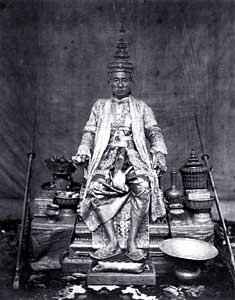
http://campus.murraystate.edu/academic/faculty/terry.strieter/image9GT.JPGRama IV, King Mongkut - Phra Chom Klao (1851-1858)
Photography could reveal a subject in different ways. From perspective or point of view for example, a photographer could make one look high and mighty by taking the photo from a low point of view. Photographs are pictures of a subject posing (otherwise it would be candid), or basically, acting and creating facial expression. It could mislead others as one may look wise, but isn't really.
Photography communicates to viewers. It is based on mood, events and personality. Photography could tell others about a person's personality and what the times were like as in if the picture was taken during the great depression. Moods from photography could reveal strength, power and knowledge. Photography allows viewers to understand past lives and even depict stories.
Future kings could use photography to store images for future reference. Other kings could refer back to old pictures to know what life was like before and what their ancestors looked like. Photography could also publicize the king's image to citizens and foreigners.
The difference in clothing is people nowadays wear suits and military uniforms. Kings also sometimes wear suits, while previously, citizens wore simple clothing where they wrap themselves with silk cloth. Contemporary clothings come in cotton and wool and other fabrics, unlike the old thai clothing which is mainly composed of silk. The hairstyles differ a lot. People back then did not have stuff like hair gel or wax to keep their hair up, so mostly they have straight hair or are bald. People nowadays take advantage of hair gel and spike it up. Fashion has changed obviously.
Similarities between the past and current clothings is basically traditional wear. Thailand has kept its cultural clothing and dancers and perhaps some extreme conservatives still wear clothing worn previously in the past. Many people, if not most, still keep short hair or long hair, not spiked up.
Rama III
Rama III, King Nangklao Chao Yuhua (1824-1851)
Rama III's focused on encourage trade routes and imports and exports with other foreign countries like China and Sri Lanka. He had to ensure that foreign countries don't take advantage of Thailand, thus he was rather aggressive in foreign policies. He was focused on attacking his brother through writings about him. To prevent the disease from spreading, Rama III also focused on Small Pox research, testing for its vaccination.
Sources: "Thailand A Simple History" and "A Window on Thai History"
Rama II
 Source: http://www.baanthai.com/magazin/media/ramaii.jpg
Rama II, King Buddha Loetla Naphalai (1809-1824)
Question:
1. What would you choose as your priorities for the rebuilding of your country?
Recover the culture of Ayutthaya. (arts, music and dancing)
Encourage Buddhism to flourish as it did in Ayutthaya.
2. How would you create a national pride amongst your people?
3. Where would you get the money for all your rebuilding?
Rama I

Source:
http://members.tripod.com/~tudtu/rama1pic.jpgRama I, King Buddha Yot Fa Chulalok (1782-1809)
Accomplishments:- Founded Bangkok, a.k.a. Krung Thep.
- Built the Temple of the Emerald Buddha.
- Changed the law to fit the new society of Thailand.
- Rewrote "Ramakien", an indian storyof the Hindu Ramayana.
- Restored Bhuddist literature and texts that lay in the ruins of Ayutthaya.
Source: "Thailand A Simple History" and "A Window on Thai History"